|
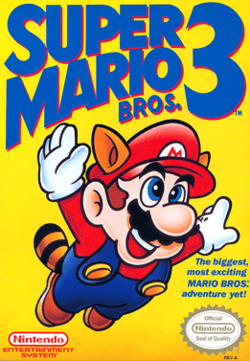
Name: Super Mario Brothers 3 |
| Release Date: October 23, 1988 | |
| Date Completed: N/A Incomplete | |
| Developer: Nintendo | |
| Producer: Shigeru Miyamoto | |
| Designer: Shigeru Miyamoto, Takashi Tezuka, Katsuya Eguchi, Hideki Konno, & Kensuke Tanabe | |
| Composer: Koji Kondo | |
| Genre: Platformer | |
| My Rating: 5/5 | |
| Pricecharting Page: Super Mario Brothers 3 | |
| Box Description: "Fight monsters, navigate hazardous terrain like water and quicksand, and dodge enemies to recover the King's wand. Key features highlighted include the raccoon suit for flight, the frog suit for swimming, new power-ups, inventory management, bonus games, and both single-player and two-player cooperative modes." | |
| Wiki Description: Players control brothers Mario or Luigi, who must save Princess Toadstool and the rulers of seven different kingdoms from the villain, Bowser. As in previous Super Mario games, they defeat enemies by stomping on them or using items that bestow magical powers; they also have new abilities, including flight and sliding down slopes. Super Mario Bros. 3 introduced Super Mario staples such as Bowser's children (the Koopalings) and a world map to transition between levels. | |
| My Image | Gameplay: In addition to the running and jumping found in previous games, the player character can slide down slopes, pick up and throw certain items, and freely climb vines. New power-ups are introduced, including the Super Leaf and the Tanooki Suit, which allow Mario to fly and float. The game world consists of eight kingdoms, each subdivided into multiple levels. The eight worlds feature distinct visual themes: the first world is grass and the second world, "Desert Land", contains sand-covered levels with pyramids, while the levels in the fourth world, "Giant Land", contain obstacles and enemies twice their normal height and width. The player navigates via two game screens: an overworld map and a course. The overworld map displays an overhead representation of the current kingdom and has several paths leading from the world's entrance to a castle. Paths connect to action panels, fortresses, and other map icons, and allow players to take different routes to reach the kingdom's goal. Moving the on-screen character to an action panel or fortress will allow access to that course, a linear stage populated with obstacles and enemies. The majority of the game takes place in these levels, with the player traversing the stage by dashing, jumping, flying, swimming, and dodging or defeating enemies |
| My Review: This is by far the best game on the NES. Platformers are not my favorite thing, but I have spent countless hours playing this game as a child. My favorite thing to do was play the competitive mode with my cousins and keep trying until we got the crab level. |