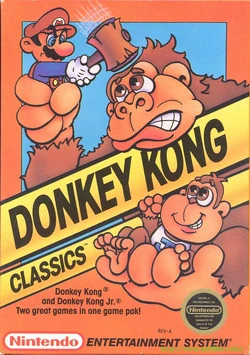
|
Name: Donkey Kong Classics |
| Release Date: October 1988 | |
| Date Completed: N/A Incomplete | |
| Developer: Nintendo | |
| Producer: Shigeru Miyamoto | |
| Designer: Shigeru Miyamoto | |
| Composer: Yukio Kaneoka | |
| Genre: Action/Platformer | |
| My Rating: 3/5 | |
| Pricecharting Page: Donkey Kong Classics | |
| Box Description: "Donkey Kong Classics brings together two arcade hits in one package, allowing players to rescue Pauline from the ape in Donkey Kong and help Junior save his father in Donkey Kong Jr. It promises high-energy, classic "monkey business."" | |
| Wiki Description: In Donkey Kong as Mario (occasionally referred to as "Jumpman" at the time), the player runs and jumps on platforms and climbs ladders to ascend a construction site in New York City and rescue Pauline (occasionally referred to as "The Lady" at the time) from the giant gorilla Donkey Kong. It is the first game in the Donkey Kong series and Mario's first appearance in a video game. In Donkey Kong Jr, Mario is now the villain and Donkey Kong Jr. is trying to save his kidnapped father. After its initial release in arcades, the game was ported to a variety of home consoles, including the Famicom/Nintendo Entertainment System (for which the game was released as a launch title in Japan). The game's title is written as Donkey Kong Junior in the North American arcade version and various conversions to non-Nintendo systems. | |
| My Image | Gameplay: As the first platformer game to feature jumping, Donkey Kong requires the player to jump between gaps and over obstacles or approaching enemies whilst Donkey Kong throws barrels at the player, setting the template for the future of the genre. In addition to the goal of saving Pauline, the player has a score. Points are awarded for the following: leaping over obstacles; destroying objects with a hammer power-up; collecting items such as hats, parasols, and purses; removing rivets from platforms; and completing each stage according to a steadily decreasing bonus counter. The player starts with three lives with a bonus life awarded at 7,000 points. A life is lost when Mario touches Donkey Kong or any enemy object, falls too far, or lets the bonus counter reach zero. The game ends when all lives are lost. In Donkey Kong JR, Donkey Kong has been defeated by Mario, who has put him in a cage in a forest. Donkey Kong's son, Donkey Kong Jr., follows Mario in an attempt to free his father. Mario transports Donkey Kong to his Hideout via helicopter, before Mario takes the keys to Donkey Kong's chains and places them around the building. Several enemies attack Donkey Kong Jr., but he escapes them and makes it to his father, releasing him from the chains as Mario falls to the ground. Donkey Kong Jr. saves Donkey Kong and the two set off together. Mario pursues the kongs, but flees after Donkey Kong knocks him back. |
| My Review: I had a lot of fun with this game as a child. This was one of the collection of first games I owned, and I returned to this game frequently to either defeat Donkey Kong or to defeat Mario. It was never one of my favorite games, but I definitely played it often enough. The musical score is one that routinely gets stuck in my head. |