- a measure of the amount of heat an object has.
- a measure of the total kinetic energy of the
particles comprising the substance. - a measure of the average potential energy of the
particles comprising the substance. - a measure of the average kinetic energy of the
particles comprising the substance. - a measure of the total potential energy of the
particles comprising the substance
- 26.634 �C
- 32.222 �C
- 56.89 �C
- 45.192 �C
- 10.908 �C
with change in temperature of a fluid in a tube.
The fluid rises to a level of 0.01 m when the temperature is
5.5 � C and to a level of 0.13 m when the temperature is
19 � C. Obtain the calibrating equation; that is a formula
for the temperature ( T ) in terms of the fluid level ( L ).
- T = 96.3 * L + 2.818
- T = 96.3 * L + 4.375
- T = 112.5 * L + 4.961
- T = 112.5 * L + 4.375
- T = 149.962 * L + 4.961
rod of length 2 m change if its length is to change by 8.5e-3 m.
(Coeeficient of linear expansion for aluminum
is 2.4e-5 ⁄ �C.)
- 327.469 �C
- 177.083 �C
- 293.193 �C
- 251.808 �C
- 273.118 �C
at a temperature of 20 �C. Calculate its radius at a temperature
of 200 �C. (Coefficient of linear expansion of
steel is 1.1e-5 ⁄ �C)
- 0.8063 m
- 0.8047 m
- 0.8016 m
- 0.8002 m
- 0.8032 m
- The combined gas law states that the volume of a
gas is directly proportional to its pressure and
inversely proportional to its temperature. - Boyle's law states that if the temperature of a
gas is kept constant, then the volume and
the pressure of the gas are directly proportional. - Charles' law states that if pressure is kept
constant, then the volume and the
temperature of the gas are inversely proportional - Charles' law states that if the temperature of a
gas is kept constant, then the volume and
the pressure of the gas are inversely proportional. - Boyle's law states that if the temperature of a
gas is kept constant, then the volume and
the pressure of the gas are inversely proportional.
90 L and its pressure is 20 kPa. Calculate its temperature when its
volume is 95 L and its pressure is 45 kPa.
- 244.923 �C
- 565.375 �C
- 508.222 �C
- 653.614 �C
- 84.29 �C
gas that occupies a volume 100 L at a pressure of 70 kPa.
(atomic mass of chlorine is 35 u ).
- 1202.904 �C
- 1548.27 �C
- 2086.001 �C
- 2252.706 �C
- 1040.931 �C
that occupies a volume 10 L at STP.
- 1.031e23
- 4.334e23
- 3.523e23
- 2.689e23
- 2.409e23
temperature of 30 �C. Calculate the total energy
(translational kinetic energy) of the sample. (atomic mass
of chlorine is 35 u. )
- 538.907 J
- 929.447 J
- 253.255 J
- 119.361 J
- 484.599 J
- 10 J
- 100 J
- 4180 J
- 418 J
- 4.18 J
supplied with a 24000 J of heat energy, its temperature increased
from 28 �C to 82 �C. Calculate the mass of
the sample.
- 3.419 kg
- 2.36 kg
- 5.183 kg
- 4.101 kg
- 6.475 kg
125 �C is mixed with 10 kg of water (specific heat capacity
4180 J ⁄ kg ⁄ �C) at a temperature of 24 �C.
The equilibrum temperature of the mixture is found to be
48 �C. Calculate specific heat capacity of the substance.
- 17371.429 J ⁄ kg ⁄ �C
- 19331.447 J ⁄ kg ⁄ �C
- 28367.91 J ⁄ kg ⁄ �C
- 32950.904 J ⁄ kg ⁄ �C
- 25686.107 J ⁄ kg ⁄ �C
2.26e6 J ⁄ kg) that can be vaporized by 7e6 J of heat energy.
- 4.708 kg
- 3.097 kg
- 0.861 kg
- 4.242 kg
- 5.567 kg
change 0.457 kg of water at a temperature of 20 �C to steam at a
temperature of 150 �C. (specific heat capacities
of ice, water and steam are 2090, 4180, 2010 J ⁄ kg ⁄ �C
respectively. Latent heat of fusion and vaporization of water are
3.34e5, 2.26e6 J ⁄ kg respectively.)
- 209910.064 J
- 1088055.193 J
- 865187.468 J
- 1231569.3 J
- 2029388.096 J
- The rate of absorption of radiation by an object
is proportional to the surface area of the object. - The net rate of emission of radiation is equal
to the difference between the emission and
the absorption rate. - The rate of absorption of radiation by an object
is proportional to the fourth power of its
temperature. - The rate of emission of radiation by an object
is proportional to the fourth power of its
temperature. - The rate of emission of radiation by an object
is proportional to the surface area of the object
has a length of 4 m and a cross-sectional radius of 0.0175 m.
Its left end and right end are at temperatures of 24 �C and 125 �C
respectively. Calculate the amount of energy transferred
from the left end to the right end in 42 minutes.
- 42245.883 J
- 7060.5 J
- 15893.463 J
- 24304.036 J
- 12574.558 J
temperature of 60 �C. Its enviornment is at a temperature of 13 �C.
Calculate the rate at which the object is emitting radiation
to its enviornment.
- 634.153 W
- 836.136 W
- 122.177 W
- 1020.808 W
- 723.994 W
temperature of 90 �C. Its enviornment is at a temperature of 16 �C.
Calculate the rate at which the object is absorbing radiation
from the enviornment.
- 94.778 W
- 719.513 W
- 465.126 W
- 1275.479 W
- 1062.765 W
equilibrium if
- if they have the same kinetic energy.
- they have the same energy.
- if they are at rest
- they have the same temperature.
- they have the same pressure.
by 100 J while being supplied with 250 J of heat energy.
Calculate the work done by (on) the system.
- 0 J
- -350 J
- -150 J
- 150 J
- 350 J
decreased by 10 L under a pressure of
200 kPa. Which of the following is a
true statement.
- 2000 J of work was done by the system on the
enviornment. - The change in internal energy or the heat supplied
(lost) can not be determined based on the given information - The internal energy of the system increased by 2000 J.
- The system gained 2000 J of heat energy.
- The change in internal energy of the system is zero.
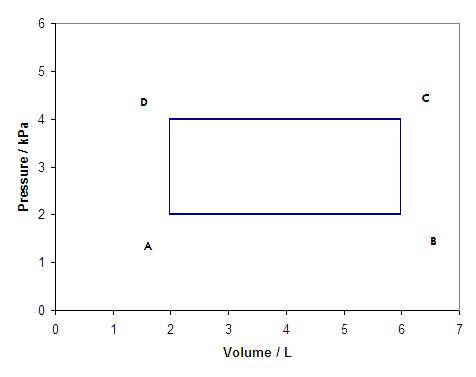
Calculate the work done in taking the system from the point D( 2 L, 4 kPa)
to the point B( 6 L, 2 kPa) along path DCB.
- -16 J
- -8 J
- 24 J
- 16 J
- 8 J
Calculate the work done by (on) the system for the cyclic
process ADCBA.
- 16 J
- -8 J
- 8 J
- -16 J
- 0 J
statement.
- The efficiency of a heat engine can never be a 100%.
- An isolated system can only proceed from order
to disorder. - The entropy of an isolated system can only decrease.
- The universe tends to go from order to disorder.
- The entropy of the gas state is greater than the
entropy of the liquid state.
from a hot reservior at a temperature of 340 �C
and gives off 833 J of energy to a cold
reservior at a temperature of 32 �C in a cyclic process.
Calculate the efficiency of the engine.
- 40.69%
- 11.862%
- 85.113%
- 21.762%
- 54.826%
heat engine that operates between a hot reservior
at a temperature of 310 �C and a cold reservior
at a temperature of 20 �C.
- 93.305%
- 49.743%
- 86.654%
- 37.47%
- 77.169%