- 2e-2 m
- 2e-3 m
- 2e2 m
- 2e-1 m
- unit of density
- unit of mass
- unit of time
- unit of current
significant figure 0.00005643
- 1
- 9
- 8
- 4
significant figures 0.00200, 10.0, and 400
respectively are
- 1, 1 and 1
- 3, 3, and 1
- 1, 3, and 1
- 3, 2, and 3
gives the significant figure
- 58
- 58.7143
- 58.7
- 59
- 4.535e2
- 4.535e3
- 4.535e-3
- 4.535e-2
following product: 346 * 8 * 5632 * 25 * 3 * 980
- 1145819136000
- 1e13
- 1e9
- 1e10
- 1e11
- 2592 m ⁄ s
- 2000 m ⁄ s
- 25.92 m ⁄ s
- 2 m ⁄ s
- 7200 m ⁄ s
- 0.009 kg ⁄ m 3
- 900 kg ⁄ m 3
- 90,000 kg ⁄ m 3
- 9000 kg ⁄ m 3
- 0.09 kg ⁄ m 3
Calculate its cartesian coordinates ( x, y ).
- (27.713 m, 16 m )
- (33.255 m, 22.4 m )
- (24.942 m, 16 m )
- (27.713 m, 12.8 m )
- (33.255 m, 17.6 m )
of a particle is called
- distance
- acceleration
- velocity
- position
- displacement

Assuming the reference point is fixed at point F,
obtain the positions of points A, F, and H respectively.
- 0 cm, 5 cm, and 7 cm
- 0 cm, -5 cm, and -7 cm
- 5 cm, 0 cm, and 2 cm
- -5 cm, 0 cm, and 2 cm
- 5 cm, 0 cm, and -2 cm
x = -7 cm in 8 seconds.
- 0.375 cm ⁄ s
- -2.125 cm ⁄ s
- 2.595 cm ⁄ s
- 0.463 cm ⁄ s
- 3 cm ⁄ s
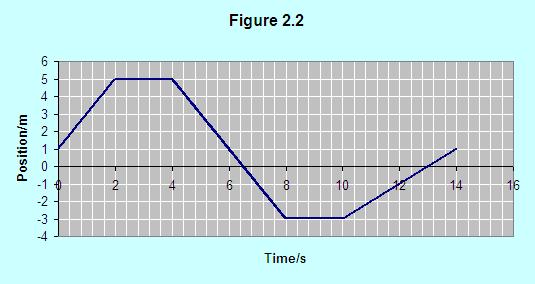
Calculate the average velocity between the third and the ninth seconds.
- -0.75 m ⁄ s
- 1.333 m ⁄ s
- 0.75 m ⁄ s
- -1.333 m ⁄ s
- -0.333 m ⁄ s
Calculate the instantaneous velocity after 12 seconds.
- 3 m ⁄ s
- 0 m ⁄ s
- 1 m ⁄ s
- -2 m ⁄ s
- 2 m ⁄ s
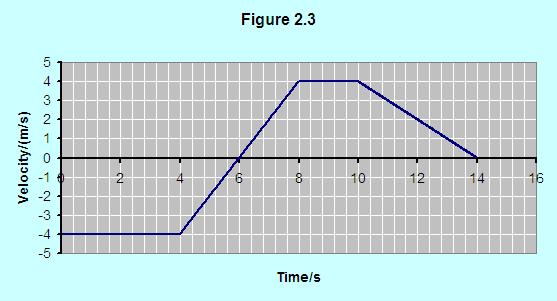
Calculate its average acceleration between the 4 th and 14 th seconds.
- -0.3 m ⁄ s 2
- -0.5 m ⁄ s 2
- 0.3 m ⁄ s 2
- 0.4 m ⁄ s 2
- 0.5 m ⁄ s 2
instantaneous acceleration
- may be the same or different
- are always different
- are always the same
- are negatives of eachother
- are reciprocals of of each other
a uniform acceleration for 7 seconds. If it was displaced by 46 m during
this time interval, calculate its acceleration.
- 10.743 m ⁄ s 2
- 1.535 m ⁄ s 2
- 2.22 m ⁄ s 2
- 0.384 m ⁄ s 2
- 1.829 m ⁄ s 2
with a uniform acceleration. Calculate the acceleration
and the distance travelled respectively.
- 12 m ⁄ s 2, 360 m
- 14.4 m ⁄ s 2, 180 m
- 14.4 m ⁄ s 2, 75 m
- 6 m ⁄ s 2, 180 m
- 6 m ⁄ s 2, 75 m
27 seconds with a uniform acceleration of 6 m ⁄ s 2. The distance
travelled and its final speed respectively are
- 4887 m and 262 m ⁄ s
- 7074 m and 262 m ⁄ s
- 7074 m and 4474 m ⁄ s
- 2781 m and 181 m ⁄ s
- 4887 m and 4474 m ⁄ s
to heat the ground. The height and its velocity just before
it hits respectively are
- 1587.6 m and -88.2 m ⁄ s
- 88.2 m and -176.4 m ⁄ s
- 3175.2 m and -352.8 m ⁄ s
- 88.2 m and -88.2 m ⁄ s
- 1587.6 m and -176.4 m ⁄ s
the vector A = 8 m 10 deg south of east is
- 10 deg
- 170 deg
- 80 deg
- -10 deg
- 100 deg
graphically represented by an arrow of length _________ and default angle
(angle measured with respect to the positive x-axis) ___________.
- 10 cm, -90 deg
- 10 cm, 90 deg
- 5 cm, -90 deg
- 5 cm, 90 deg
- 0.2 cm, 180 deg
A = 770 m 50 deg east of south.
- ( 589.854 m, -334.725 m )
- ( 150.198 m, -494.946 m )
- ( 150.198 m, -334.725 m )
- ( 973.573 m, -635.248 m )
- ( 589.854 m, -494.946 m )
y components are -4 m and 7 m respectively.
- 11 m
- 4.796 m
- 8.062 m
- 3.317 m
- 65 m
north of east and B = 20 m 40 deg north of east,
find the x and y components of their sum vector A + B.
- ( 73.449 m, 16.579 m )
- ( 121.404 m, 12.733 m )
- ( 121.404 m, 21.538 m )
- ( 64.561 m, 21.538 m )
- ( 64.561 m, 12.733 m )
- The numerical value of gravitation acceleration
is 9.8 m ⁄ s 2 - Average acceleration is change in displacement
per a unit time. - The unit of measurement for acceleration is m ⁄ s 2.
- Gravtational acceleration is negative.
- A uniformly accelerated motion is motion with
constant acceleration.
Calculate the horizontal component of its average velocity.
- -0.9 m ⁄ s
- -0.5 m ⁄ s
- 0.6 m ⁄ s
- 0.5 m ⁄ s
- -0.6 m ⁄ s
tall building with a speed of 1200 m ⁄ s.
How long will it take to hit the ground?
- 5.029 s
- 4.041 s
- 2.949 s
- 6.122 s
- 2.445 s
with the horizontal with a speed of 1400 m ⁄ s.
Calculate the maximum height reached?
- 88302.222 m
- 9122.107 m
- 143230.371 m
- 71332.146 m
- 109532.479 m