position is called
- speed
- position
- displacement
- velocity
- distance
- meter * second 2
- meter 2 ⁄ second 2
- meter ⁄ second 2
- meter * second
- meter ⁄ second
obtained from a graph of
- velocity versus time as the area enclosed
between the velocity versus time curve and the time axis - velocity versus position as the slope of the line
joining the two events - velocity versus time as the slope of the line
joining the two events - acceleration versus time as the slope of the
line joining the two events - position versus time as the slope of the line
joining the two events

Assuming the reference point is fixed at point C,
obtain the positions of points A, E, and H respectively.
- -3 cm, 1 cm, and 4 cm
- 0 cm, 4 cm, and 7 cm
- 2 cm, 2 cm, and 5 cm
- 3 cm, 1 cm, and 4 cm
- -2 cm, 2 cm, and 5 cm
Particle 1 is displaced from point H to point E and particle 2 is displaced from point C to point A.
The displacements of particles 1 and 2 respectively are
- 2 cm, 1 cm
- -2 cm, -1 cm
- -3 cm, 2 cm
- 3 cm, 2 cm
- -3 cm, -2 cm
x = 9 cm in 8 seconds.
- 0.865 cm ⁄ s
- 4.286 cm ⁄ s
- 2.375 cm ⁄ s
- 3.865 cm ⁄ s
- 2.813 cm ⁄ s
the point x = 19.764 cm. And then it is displaced back to the point 2.765 cm.
Determine its displacement and the distance it travelled respectively.
- -4.567 cm, 29.431 cm
- -8.291 cm, 29.431 cm
- -4.567 cm, 33.116 cm
- -6.957 cm, 17.364 cm
- -8.291 cm, 33.116 cm
the point x = 20 cm in 5 seconds. And then it is displaced back to the point 8 cm in 3.33 seconds.
Calculate its average velocity and its average speed respectively.
- 0.078 cm ⁄ s, 3.001 cm ⁄ s
- 0.078 cm ⁄ s, 3.986 cm ⁄ s
- 0.12 cm ⁄ s, 3.001 cm ⁄ s
- 0.132 cm ⁄ s, 0.47 cm ⁄ s
- 0.12 cm ⁄ s, 3.986 cm ⁄ s
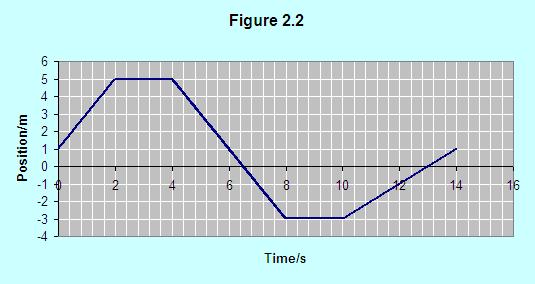
Calculate the average velocity between the third and the ninth seconds.
- -0.75 m ⁄ s
- -0.333 m ⁄ s
- 1.333 m ⁄ s
- -1.333 m ⁄ s
- 0.75 m ⁄ s
On what interval(s) of time is it moving to the left.
- 0-2 s, 4-8 s, and 10-14 s
- 0-2 s, and 10-14 s
- 0-8 s
- 4-8 s
- 10-14 s
Calculate the instantaneous velocity after 12 seconds.
- 0 m ⁄ s
- 3 m ⁄ s
- 1 m ⁄ s
- 2 m ⁄ s
- -2 m ⁄ s
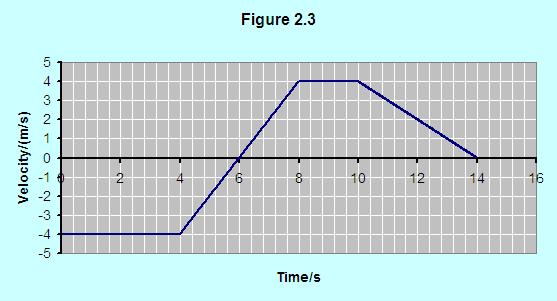
Calculate its average acceleration for the entire trip.
- -4.32 m ⁄ s 2
- 0.286 m ⁄ s 2
- 0 m ⁄ s 2
- 0.197 m ⁄ s 2
- 3.5 m ⁄ s 2
Calculate its displacement between the 6 th and 8 th seconds.
- 4 m
- 8 m
- 5 m
- 3 m
- 6 m