- A cyclic process is a process where the pressure remains constant.
- For a cyclic process, the heat supplied to (lost by)
a system is zero. - For a cyclic process, the work done on (by) the
system is zero. - For a cyclic process, the change in the internal
energy of the system is zero. - In a PV diagram, the heat supplied to (lost by)
the system is obtained as the area of the closed curve.
enviornment. If at the same time it gained 75 J of energy,
calculate the change in its internal energy.
- -85 J
- 65 J
- 0 J
- 85 J
- -65 J
to 15 J while losing 550 J of heat energy. Calculate the work
done by (on) the system.
- 0 J
- 265 J
- -265 J
- 835 J
- -835 J
under a pressure of 70 kPa while gaining 105 J
of internal energy. Calculate the amount of
supplied or lost.
- 0 J
- 1295 J
- -1505 J
- 1505 J
- -1295 J
100 J of heat energy. Which of the
following is a correct statement?
- The change in its internal energy is zero.
- The internal energy of the system increased by 100 J.
- The change in internal energy or the work done
can not be determined based on the given information. - 100 J of work was done by the enviornment on the system
- The work done by (on) the sytem is zero.
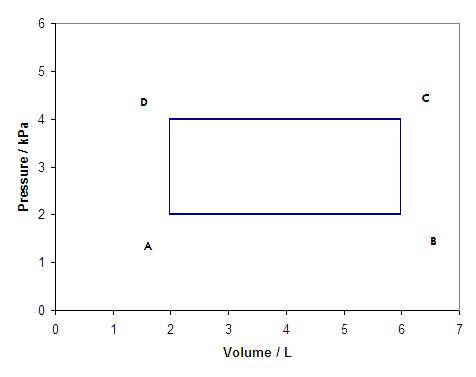
Calculate the work done in taking the system from the point D( 2 L, 4 kPa)
to the point B( 6 L, 2 kPa) along path DCB.
- 24 J
- -8 J
- -16 J
- 8 J
- 16 J
Calculate the heat supplied (lost) in taking the system from the
point B( 6 L, 2 kPa) where its internal energy is 70 J
to the point D( 2 L, 4 kPa), where its internal energy
is 65 J, along path BAD.
- 3 J
- -13 J
- 11 J
- -17 J
- -21 J
Calculate the work done by (on) the system for the cyclic
process ABCDA.
- 0 J
- 16 J
- -16
- -8 J
- 8 J
Calculate the heat supplied to (lost by) the system
for the cyclic process ADCBA.
- 8 J
- 16 J
- 0 J
- -16 J
- -8 J
- that increases its Gibb's function (free energy).
- that lowers its enthaly.
- that lowers its entropy.
- that lowers its kinetic energy
- that increases its potential energy.
from a hot reservior at a temperature of 310 �C
and gives off 780 J of energy to a cold
reservior at a temperature of 38 �C in a cyclic process.
Calculate the amount of work done per cycle.
- 1690 J
- 910 J
- 2080 J
- 0
- 520 J
vaporization of 0.6 kg of water.(Latent
heat of vaporization for water is 2.26e6 J ⁄ kg).
- 5907.336 J ⁄ �K
- 2049.771 J ⁄ �K
- 1136.837 J ⁄ �K
- 3635.389 J ⁄ �K
- 4135.769 J ⁄ �K