measurement have?
- 4
- 1
- 2
- 3
the following equations is dimensionally
correct
- time 2 = distance ⁄ speed 2
- time 2 = distance ⁄ acceleration
- time 2 = acceleration ⁄ speed
- time 2 = speed ⁄ acceleration
- time 2 = acceleration ⁄ distance
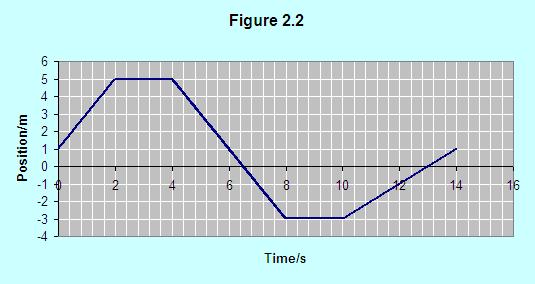
Calculate the average velocity for the first 4 seconds.
- 4 m ⁄ s
- 0.5 m ⁄ s
- 2 m ⁄ s
- 1 m ⁄ s
- 0 m ⁄ s
from 400 m ⁄ s to 1300 m ⁄ s in a distance of 2050 m.
Its acceleration and the time taken respectively are
- 373.171 m ⁄ s 2 and 2.412 s
- 0.22 m ⁄ s 2 and 1.206 s
- 0.22 m ⁄ s 2 and 2.412 s
- 451.22 m ⁄ s 2 and 1.206 s
- 373.171 m ⁄ s 2 and 1.206 s
the vector A = 2 m west is
- 0 deg
- 180 deg
- -90 deg
- 90 deg
- 270 deg
with the horizontal with a speed of 1400 m ⁄ s.
How far (horizontally) will it fall?
- 80827.062 m
- 128557.522 m
- 239321.318 m
- 105402.096 m
- 62345.45 m
- The force acting on an object is directly
proportional to the acceleration produced by
the force. - For every reaction, there is an equal reaction
in the same direction. - Any two objects in the universe attract each
other with a force directly proportional to
the product of the masses and inversely
proportional to the square of the distance
separating them. - For every action, there is an equal but opposite
reaction. - An object will remain at rest or move in a
straight line unless acted upon by a net
force.
attached by a string. If the 11 kg object is being pulled
by a force of 240 N. Calculate their acceleration.
- 9.143 m ⁄ s 2
- 1.166 m ⁄ s 2
- 21.818 m ⁄ s 2
- 11.429 m ⁄ s 2
- 24 m ⁄ s 2
an object of mass 9 kg is displaced from
point A to point B. Its potential energy and speed at point A
respectively are 850 J and 22 m ⁄ s. Its potential energy at point B is -100 J.
Calculate its speed at point B.
- 26.365 m ⁄ s
- 39.36 m ⁄ s
- 32.807 m ⁄ s
- 47.268 m ⁄ s
- 22.254 m ⁄ s
- Work done by non conservative forces is equal to
the change in the kinetic energy of the object. - Net work done on an object is equal to the
change in the mechanical energy of the object. - Net work done on an object is equal to the
change in the kintic energy of the object - Work done by conservative forces is equal to the
change in the kinetic energy of the object. - Work done by conservative forces is equal to the
change in the mechanical energy of the object.
object is equal to
- the acceleration of the object
- the mechanical energy of the object
- the kinetic energy of the object
- the potential energy of the object
- the force acting on the object
mass 12 kg if its kinetic energy is 10 J.
- 12.796 kg m ⁄ s
- 26.048 kg m ⁄ s
- 2.087 kg m ⁄ s
- 23.465 kg m ⁄ s
- 15.492 kg m ⁄ s
radius 4 m with a uniform speed. If it makes
19 cycles per second, calculate its
centripetal acceleration.
- 91257.367 m ⁄ s 2
- 22523.785 m ⁄ s 2
- 79359.429 m ⁄ s 2
- 51052.565 m ⁄ s 2
- 57006.835 m ⁄ s 2
of 40 m. Calculate the angular displacement
of a point on the rim of the wheel.
- 4.917 rad
- 7.961 rad
- 12.468 rad
- 1.841 rad
- 6.667 rad
pivoted at its mid-point. The following forces
are acting on the lever: a 0.23 N vertically upward force
acting at the right end of the lever, a 2 N
vertically upward force acting at the left end of the
lever, and a 11 N vertically downward force acting at a
point on the lever 0.9 m away from the right end.
Calculate the net torque acting on the lever.
- -27.581 N m
- -3.683 N m
- -20.748 N m
- -21.852 N m
- -30.898 N m
at the points ( -12, 3 ) m, ( -5, 5 ) m, and ( 14, -3 ) m respectively.
Calculate the moment of inertia of these system of particles if
the axis of rotation is the x-axis.
- 224.5 kg m 2
- 347.939 kg m 2
- 22.869 kg m 2
- 115.476 kg m 2
- 318.334 kg m 2
cross-sectional radius of 0.003 m. Calculate the change in
its length when an object of weight 90 N hangs from the wire.
(modulus = 7e10 Pa)
- 1.518e-5 m
- 15.731e-5 m
- 3.782e-5 m
- 13.642e-5 m
- 5.549e-5 m
of density 2500 kg ⁄ m 3 with 50 % of its volume
immersed in the fluid.
- 2072.601 kg ⁄ m 3
- 1434.317 kg ⁄ m 3
- 1852.326 kg ⁄ m 3
- 1250 kg ⁄ m 3
- 797.438 kg ⁄ m 3
temperature of 20 �C. What should its temperature
be if its length is to increase by 0.004 m. (Coefficient of
linear expansion for aluminum is 2.4e-5 ⁄ �C).
- 291.783 �C
- 138.514 �C
- 42.416 �C
- 186.667 �C
- 118.644 �C
of 90 kPa. Calculate its volume when its pressure
is changed to 45 kPa at constant temperature.
- 17.328 L
- 12 L
- 9.52 L
- 13.866 L
- 8.216 L
of ice (Latent heat of fusion 3.34e5 J ⁄ kg).
- 2672000 J
- 3376316.722 J
- 1905304.128 J
- 2186520.004 J
- 1422067.935 J
- by means of movement of air molecules.
- by means of collisions of neighboring molecules.
- by means of the actual movement molecules.
- by means of emission of particles.
- by means of propagation of electromagnetic waves.
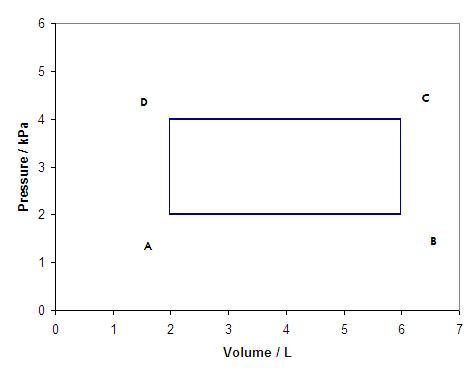
Calculate the work done in taking the system from the point C( 6 L, 4 kPa)
to the point A( 2 L, 2 kPa) along path CDA.
- 24 J
- -8 J
- -16 J
- 8
- 16 J
from a hot reservior at a temperature of 380 �C
and gives off 760 J of energy to a cold
reservior at a temperature of 32 �C in a cyclic process.
Calculate the amount of work done per cycle.
- 0
- 1220 J
- 1980 J
- 2360 J
- 840 J