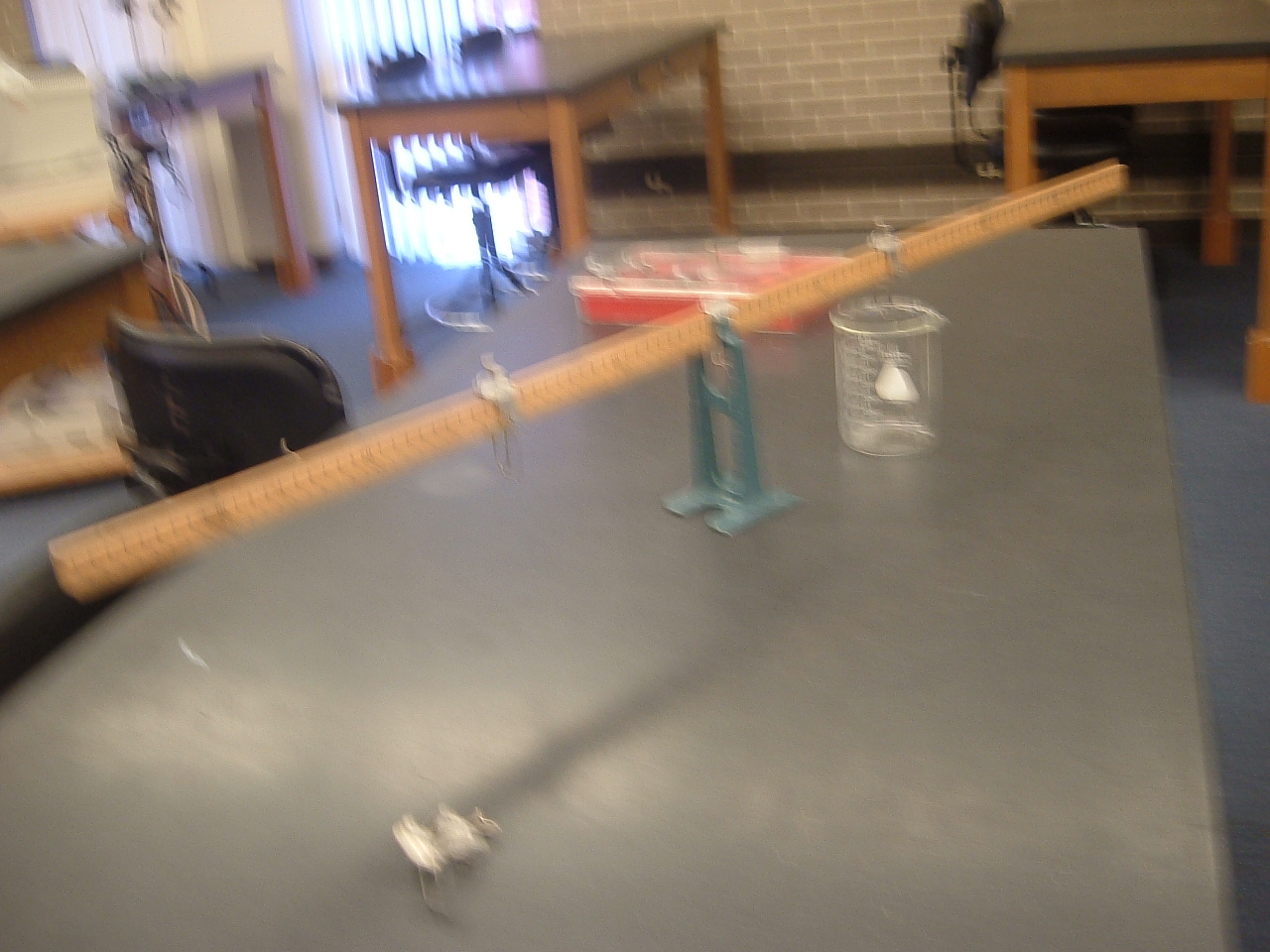
Because of this bouyant force, an object immersed in fluid weighs less than an object weighs in air. The bouyant force ( B ) is equal to the difference between the weight of the object in air ( Wair ) and the weight of the object in the fluid ( Wfluid ).
B = Wair - Wfluid . . . . . ( 1 )
Also, according to Archimede’s principle, the bouyant force is equal to the weight of the displaced fluid. Thus, if the volume of the object is V and the density of the fluid is ρfluid , the bouyant force ( B ) is also given by
B = ρfluid V|g| . . . . . ( 2 )
Comparing equations ( 1) and ( 2 ), the following expression for the volume of the object can be obtained.
V = ( Wair - Wfluid ) ⁄ ( ρfluid |g| ) . . . . . ( 3 )
weight in water ( Wwater ) = ( m2 |g|r⊥2water ⁄ r⊥1 ) - m1 |g| =
According to Archimede’s principle, the bouyant force ( B ) which is equal to the difference between the weight in air and the weight in water, is equal to the weight of displaced water. So if the volume of the rectangular object is V and the density of water is ρwater = 1000 kg ⁄ m 3, then
Vρwater |g| = Wair - Wwater
Therefore the volume of the rectangular object ( V ) may be calculated from
V = ( Wair - Wwater ) ⁄ ( ρwater |g| )