Experiment 7: Uniform Circular Motion

The aim of the experiment is to determine the force due to a spring as a centripetal force by means of the equations of a uniform circular motion and by means of hanging weights that produce the same extension as the centripetal force and compare. The equipment needed includes
  1. a motor
  2. centripetal force apparatus
  3. a timer
  4. a meter stick
  5. a vernier caliper
  6. a set f weights

Theory

A uniform circular motion is motion in a circular path with a constant speed. Even though its speed is constant, uniform circular motion is an accelerated motion because the direction of the velocity is changing constantly. Since this acceleration (centripetal or radial acceleration) is acceleration that does not affect the speed its direction must be perpendicular to the trajectory of the object which is tangent to the circle. Therefore, the direction of this acceleration is always directed toward the center of the circle. The value of the centripetal acceleration ( ac ) is given in terms of the speed of the object ( v ) and the radius of the circle ( r ) by:

ac = v 2 ⁄ r . . . . . ( 1 )

The force responsible for this acceleration is called centripetal force ( Fc ). The centripetal force of an object of mass, m , revolving in a circular path of radius r with a constant speed v is given from Newton’s second law as:

Fc = mac = mv 2 ⁄ r . . . . . ( 2 )

The direction of the centripetal acceleration is parallel to that of the centripetal acceleration which is towards the center.

The time taken for one revolution is called the period ( T ). The period may be obtained by dividing the circumference of the circle ( 2πr ) by the speed ( r ).

T = 2πr ⁄ r

or

v = 2πr ⁄ r . . . . . ( 3 )

Substituting for v from equation ( 3 ) into ( 2 ) we get

Fc = 4mπ 2r ⁄ T 2 . . . . . ( 4 )

Thus, if the mass of the rotating cylinder, m, the period, T, and the radius of revolution, r, are known, the centripetal force, Fc, may be calculated. In this experiment, the rotating cylinder is attached to a spring which means the centripetal force is supplied by the force of the spring. This means the centripetal force can also be determined by finding a hanging weight that results in the same extension of the spring as the centripetal force did. If the mass of the hanging weight that produces the same extension as the centripetal force is mh, then the centripetal force, Fc , may also be calculated as the weight of the mass of the hanging weights ( mh ) as

Fc = ( mh ) |g| . . . . . ( 5 )

Procedure

  1. Obtaining the force exerted by the spring as a centripetal force
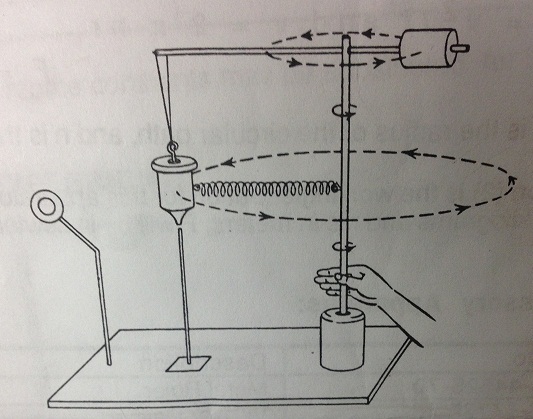
    1. Secure the radius indicator at the minimum possible distance from the shaft of the centripetal apparatus.
    2. Measure the mass of cylinderical mass with a pointed end by means of a balance.

      cylinder mass ( m ) = kg = 0.47 kg

    3. The radius of rotation is the distance from the center of the shaft to the radius indicator. This may be obtained by adding the distance from the surface of the shaft to the radius indicator and the radius of the shaft. Measure the radius of the shaft by means of a vernier caliper and the distance from the surface of the shaft to the radius indicater by means of a meter stick.

      radius ( r ) = m

      Record this at the first row of the first column of the table.

    4. Susspend the cylinderical object with pointed end from the string attached to the cross-arm. Adjust the cross-arm so that the pointed end of the cylinder is directly above the radius indicator. The pointed end of the cylinder and the radius indicator need to be very close to eachother (separated by about 2mm). This may be done by adjusting the hanging string. Also make sure the hole on the side of the cylinder from which the spring is to be attached points towards the spring when it is freely suspended.This may be done by adjusting the screw at the top of the cylinder with the pointed end.

    5. Make sure the shaft is vertical by adjusting the 3 legs of the centripetal apparatus. When the shaft is vertical, the freely suspended cylinder should not have a tendency to rotate at any position.

    6. Turn the screw to which the spring is rotated all the way to the shaft so that one end of the spring is at the shaft. Now attach the spring to the cylinder with pointed end by means of the hole on the side of the cylinder.

    7. Now the pointed end of the cylinder is no longer directly above the radius indicator because it is being attracted by the spring. Rotate the cylinder by applying torque on the shaft by your fingers fast enough so that the pointed end of the cylinder passes directly above the radius indicator. Make sure the pointed end of the cylinder passes direcly above the radius indicator for all of the revolutions by applying torque on the shaft by your fingers.

    8. Measure the time taken for 50 revolutions. Calculate the time taken for one revolution (period) by dividing the time taken for 50 revolutions by 50.

      period ( T ) = s

      Record this at the first row of the second column of the table.

    9. The speed ( v ) of the rotating cylinder may be calculated by dividing the circumference of revolution ( 2πr ) by the time taken for one revolution which is the period ( T ).

      v = 2πr ⁄ T

      Using the radius ( r ) obtained in procedure (3.) and the period ( T ) obtained in procedure (8.) calculate the speed ( v )

      speed ( v ) = 2πr ⁄ T = m ⁄ s

      Record this at the first row of the third column of the table.

    10. Because it is moving in a circular path, it has a centripetal acceleration which is directed towards the center. The centripetal force ( Fc ) responsible for this acceleration is the force due to the spring which is attached to the rotating object. From Newton’s second law, this may be obtained as the product of the mass of the rotating cylinder ( m ) and its centripetal acceleration ( ac = v 2 ⁄ r ).

      Fc = mv 2 ⁄ r

      Using the mass of the cylinder ( m ) obtained in procedure (2.), the speed ( v ) obtained in procedure (9.), and the radius ( r ) obtained in procedure (3.), calculate the centripetal force which is the force exerted by the spring.

      centripetal force ( Fc ) = N

      Record this at the first row of the fourth column of the table.

  2. Obtaining the force of the spring by a hanging weight that causes the same extension as the centripetal force
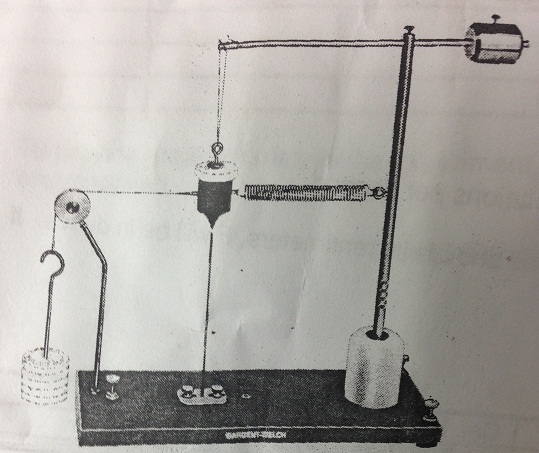
    1. Bring the rotating shaft to a stop. Connect the cylinder with a pointd end to a hanger via a pulley by means of a string. Put enough weight on the hanger so that the pointed end of the spring is directly above the radius indicator. (Remember the mass of the hanger itself ( 50 g) is part of the hanging mass).

      hanging mass ( mh ) = kg

      Record this on the first row of the fifth column of the table.

    2. The force ( Fs ) due to the hanging weight that causes the same extension on the spring may be calculated from:

      Fs = ( mh ) |g|

      Using the mass of the hanging weights ( mh ) obtained in procedure (1.), calculate the force ( Fs ) that causes the same extension as the rotating object.

      weight force ( Fs ) = ( mh ) |g| =

      Record this at the first row of the sixth column of the table.

    3. The centripetal force ( Fc ) and the force due to the weights ( Fs ) are expected to be equal because they cause the same extension on the spring. Compare both by calculating their ratio.

      ratio = Fc ⁄ Fs =

      Record this on the first row of the seventh column of the table.

    4. Repeat procedures (I.3.) through (II.3.) four more times by increasing the radius of rotation by 2 cm each time.

      Table 1
      update table

    5. Calculate the average of the ratio between the centripetal force and the force due to the weights obtained in column seven.

      average ratio =

    6. The ratio between the centripetal force and the force due to the weights ( Fc ⁄ Fs ) is expected to be one because they both cause the same extension on the spring. Compare your experimental value of the average ratio (procedure II.5.) with the expected value of one by calculating the percentage error.

      % error = | { average ratio ( II.5. ) - 1 } ⁄ 1 | * 100% =