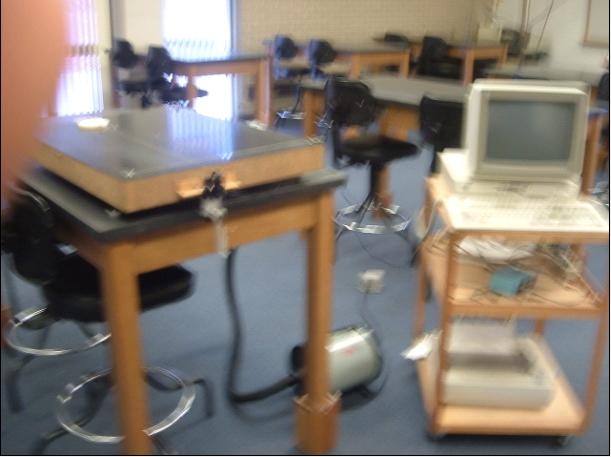
Experiment 5: Friction

The aim of the experiment is to determine the coefficient of friction from a uniform motion and an accelerated motion and compare. The equipment needed includes

  1. air table
  2. blower
  3. smart pulley
  4. vernier caliper
  5. puck
  6. hunger
  7. weights
  8. balance

Theory

The Smart Pulley

The smart pulley is essentially a photo gate that allows you to measure time intervals for consecutive constant distance intervals. One distance interval is one tenth of its circumference.

The acceleration may be calculated by using two consecutive intervals. Let t1 be the first time interval of the two consecutive intervals and t2 be the second time interval of the two consecutive time intervals. Let the constant distance interval be represented by s. If the acceleration, a, is constant, then the equations of a uniformly accelerated motion apply. For the first interval the following equation applies:

s = v1i t1 + at1 2 ⁄ 2 . . . . . .(1)

where v1i is the initial velocity of the first interval. And for the second interval the following equation applies:

s = v2i t2 + at2 2 ⁄ 2 . . . . . .(2)

where v2i is the initial velocity of the second interval. The final velocity, v1f, of the first interval is the same as the initial velocity, v2i, of the second interval. Therefore,

v2i = v1f = v1i + at1 . . . . . .(3)

Substituting equation (3) into equation (2) we obtain

s = v1it1t2 + a ( t1t2 + t1 2 ⁄ 2 ) . . . . . ( 4 )

The time intervals, t1 , t2 and the constant distance interval, s, will be measured. Thus, we will have only two unknowns, v1i and a, in equations (1) and (4). That means we can solve for the acceleration a simultaneously in terms of t1 , t2 and s to obtain

a = 2s ( t1 - t2 ) ⁄ [ t1 t2 ( t1 + t2 ) ] . . . . . ( 5 )

That is, if two consecutive time intervals and the constant distance interval are measured, the acceleration can be calculated.

Friction

Friction is the force that exists between two surfaces in contact. The force of friction is proportional to the normal force pressing the two surfaces together. The constant of proportionality between the force of friction ( f ) and the normal pressing force ( N ) is called the coefficient of friction ( μ ) between the two surfaces.

To calculate the coefficient of friction, we will use an arrangement where an object of mass m1 sliding on a table is attached to a hanging object of mass m2 by means of a string passing through a pulley. The forces acting on the object sliding on the table ( m1 ) are the tension in the string which is equal to the weight of the hanging object (Weight of hanging object = m2 |g| ) and the force of friction ( f ) between the two surfaces. The normal pressing force is equal to the weight of the sliding object. (Weight of sliding object = m1 |g| ). Therefore f = μm1 |g|. Since the direction of friction is opposite to the direction of motion, the net force acting on the sliding object is the difference between the tension in the string = and the force of friction. Applying Newton’s second law to the acceleration of these two objects we obtain,

m2 |g| - μm1 |g| = (m1 + m2 ) a

where g is the gravitational acceleration whose value is –9.8m/s2. Now solving for the coefficient of friction ( ), we get,

μ = { m2 |g| - ( m1 + m2 ) a } ⁄ ( m1 |g| )

Therefore if the masses m1 , m2 and the acceleration, a, are measured, the value of the coefficient of friction ( μ ) can be calculated.

And if an experiment is designed so that the motion is uniform (i.e, a = 0 ), the coefficient of friction may be calculated by setting the acceleration to zero in the above equation:

μ = m2 ⁄ m1

An approximate uniform motion can be obtained by finding a mass of the hanging object for which after the sliding object is given a little push, the sliding object moves with a uniform speed in the immediate local area. (Only the immediate local area should be considered because the value of the coefficient of friction may vary from place to place slightly.)

Procedure

  1. To determine coefficient of friction from measurement of acceleration.

    1. Measure the mass ( m1 ) of the puck (cylindrical object) by means of a balance.

      puck mass ( m1 ) = kg = 0.038 kg

      Record this in the first row of the first column of the Table.

    2. Measure the diameter of the smart pulley by means of a vernier caliper. (Note: make sure to measure the diameter between the edges where the string would slide)

      diameter ( d ) = m

      The circumference of the pulley is divided into ten equal distance intervals. The smart pulley measures the time taken for each of these intervals. To determine the length ( s ) of this interval, first calculate the circumference and then divide by ten.

      interval distance ( s ) = πd ⁄ 10 = m

    3. Connect the blower to the air table. Place the puck on the air table and turn on the blower. Level the table by adjusting the screws (The legs of the air table are adjustable screws) until there is no net tendency for the puck to go in any direction.

    4. Turn off the blower (The blower will not be used any further). Connect the smart pulley to the air table along the edge of the table.

    5. Connect the puck (cylindrical plastic) to a string, pass the string through the smart pulley and then connect it to the hanger. Put an additional mass of 20 g on the hanger.The mass ( m2 ) of the hanging object is the sum of the additional mass ( 20 g ) and the mass of the hanger. The mass of the hanger is marked on it. Read this mass.

      hanger mass = kg = 0.005 kg

      hanging mass ( m2 ) = kg

    6. connect the smart pulley to the computer (on the computer choose smart pulley and then motion timer).

    7. Position the puck at the rear of the air table hold it to stop it from moving.

    8. Let it go and the puck will start sliding.

    9. The computer will record time taken for the constant distance intervals of length s. (i.e, one tenth of the circumference of the pulley.) Pick any two consecutive time intervals, preferably the third and the fourth time intervals. Represent the first of these time intervals by t1 and the second one by t2 .

      first time interval ( t1 ) =

      second time interval ( t2 ) = s

      Record t1 on the first row of column 2 and t2 on the first row of column 3 of the Table .

    10. Applying the equations of a uniformly accelerated motion to the two intervals and solving the system of simultaneous equations, we can obtain the following expression for the acceleration ( a ) of the system in terms of the time intervals t1 and t2 , and the distance traveled in each interval, s (For details look at the theory section of the manual).

      a = 2s ( t1 - t2 ) ⁄ [ t1 t2 ( t1 + t2 ) ]

      Using the time intervals, t1 and t2 obtained in procedure (9.) and the distance of one interval ( s ) obtained from procedure (2.), calculate the acceleration of the system.

      acceleration ( a ) = 2s ( t1 - t2 ) ⁄ [ t1 t2 ( t1 + t2 ) ] = m ⁄ s 2

      Record this on the first row of column 4 of the table.

    11. The net force acting on the system is the difference between the weight of the hanging object ( m2 |g| ) and the force of friction acting on the sliding object ( f = μN = μm1 |g| ). Therefore applying Newton’s second law to this system we get,

      m2 |g| - μm1 |g| = (m1 + m2 ) a

      Therefore if the masses and their acceleration are known the coefficient of friction, μ, may be calculated from

      μ = { m2 |g| - ( m1 + m2 ) a } ⁄ ( m1 |g| )

      Using the mass, m1 , obtained from procedure (1.), the mass, m2 , obtained from procedure (5.), and the acceleration of the system obtained from procedure (10.), calculate the value of the coefficient of friction.

      coefficient of friction ( μ) = { m2 |g| - ( m1 + m2 ) a } ⁄ ( m1 |g| ) =

      Record this on the first row of column 5 of the Table.

    12. Repeat procedure (7.) through (11.) by adding an additional mass of 10 g, 20 g, 30 g and 40 g to the puck to complete the table. (Note: the mass m1 will be the sum of the mass of the puck and the additional mass) Attach the additional mass to the puck with a tape to make sure it doesn’t move around on the top of the puck.

      Table 1
      update table
    13. Calculate the average of the coefficients of friction obtained on column 5 of the table.

      average =

    14. To determine the coefficient of friction from a uniform motion (zero acceleration) of the system

      1. Attach an additional mass of 100 g to the puck and tape it to make sure it doesn’t move around on the top of the puck. Connect a string to the puck and then to the hanger via the smart pulley. The mass of sliding object is the sum of the additional mass ( 100 g ) and the mass of the puck ( procedure II.1.)

        sliding mass ( m1 ) = kg

      2. Because of friction the puck will not be moving. Keep adding additional masses to the hanger until the puck just starts moving. Determine this mass that just gets it start moving to the nearest gram; i.e; use one gram weights as your increment. Once you have determined this mass, determine the amount of mass that will make it move with an approximate uniform motion after it is given a little push by decreasing the mass of the hanging weight in steps of one gram.

        hanging mass ( m2 ) = kg

      3. If the object on the table is moving with a uniform speed (zero acceleration), then the force of friction ( f = μN = μm1 |g| ) must have been balanced by the weight of the hanging object (weight = m2 |g|). Thus,

        μm1 |g| = m2 |g|

        If the masses m1 and m2 are known, the coefficient of friction ( μ ) may be calculated from

        μ = m2 ⁄ m1

        Using the sliding mass m2 obtained from procedure (1.) and the hanging mass ( m2 ) obtained from procedure (2.), calculate the coefficient of friction ( μ ).

        coefficient of friction ( μ ) = m2 ⁄ m1 =

      4. Compare the average of the coefficients of friction obtained in procedure (I.13.) with the with the coefficient of friction of procedure (II.3.) by calculating the percentage error.

        % error = |{coefficient of friction (I.13.) - coefficient of friction (II.3.) } ⁄ ( coefficient of friction (I.13.)| * 100% = %