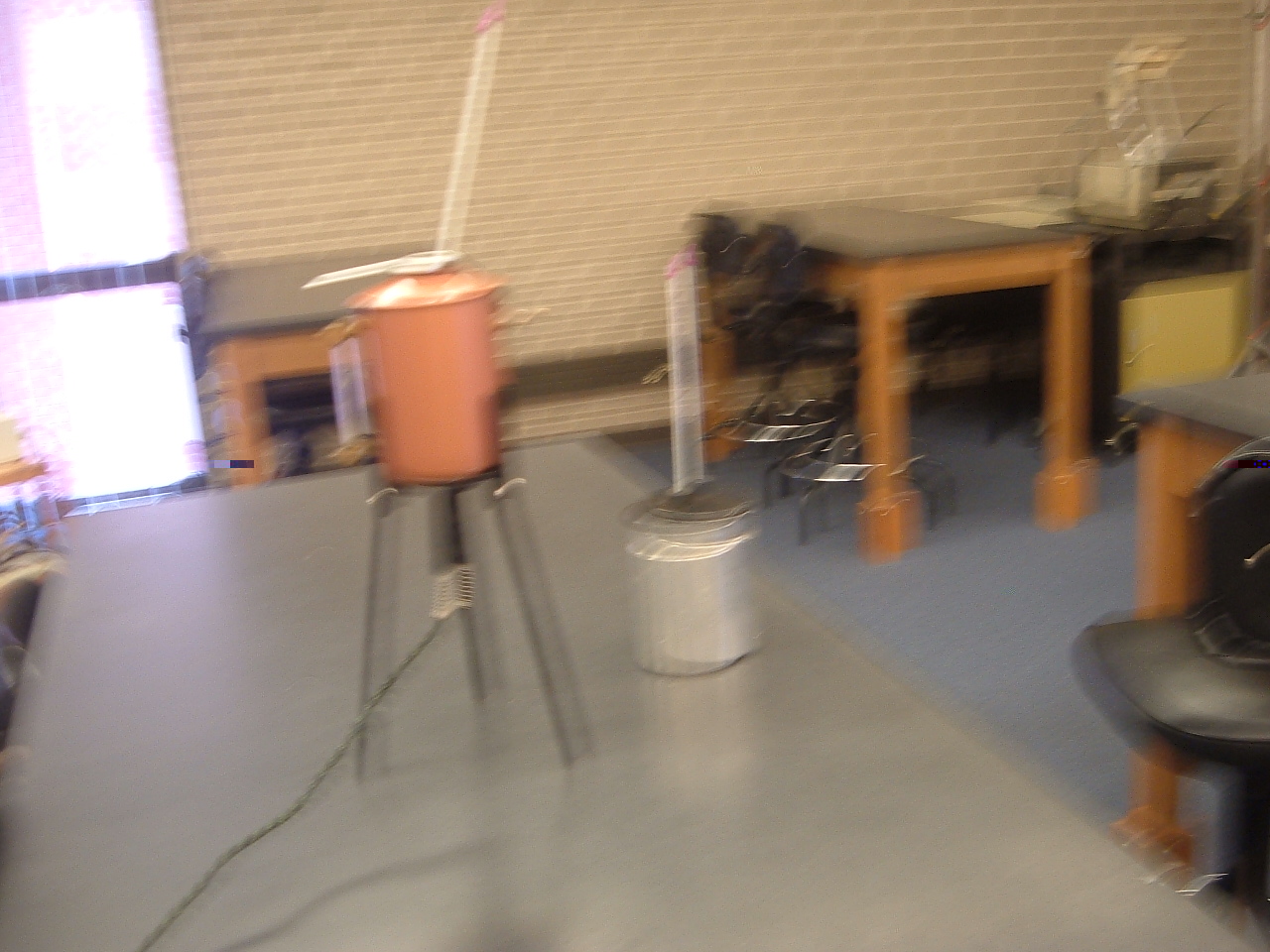
Experiment 11: Specific Heat of Metals

The aim of this experiment is to determine the specific heat of aluminum using the method of mixtures. The equipment needed include:
  1. A calorimeter
  2. a boiler
  3. a balance
  4. thermometers
  5. a stool
  6. a heater
  7. a cup
  8. aluminum shots

Theory

A Calorimeter

A calorimeter is a device that enables one to measure changes of heat energy with a minimal loss of heat energy to the environment. It is essentially a cup surrounded by air which is a bad conductor of heat. It involves of a large cup, a small cup and a cover which is also a bad conductor of heat.

Method of Mixtures When a hot substance is mixed with a cold substance heat will flow from the hot substance to the cold substance until both of them have the same equilibrium temperature. From conservation of energy, the energy lost by the hot substance ( Qloss ) and the energy gained by the cold substance ( Qgain ) must be numerically equal.

Qloss = - Qgain . . . . . ( 1 )

The negative sign is required because heat lost is negative and heat gained is positive.

Change in heat is proportional to the corresponding change in temperature ( ΔT = Tf - Ti ) and to the mass of the sample ( m ). The constant of proportionality is a material constant called the specific heat of the material ( c ).

Q = mcΔT = mc ( Tf - Ti ) . . . . . ( 2 )

Suppose a hot substance of mass mh and specific heat ch at an initial temperature of Thi is mixed with a colder substance of mass mc and specific heat cc at an initial temperature of Tii and the final equilibrium temperature of the mixture is found to be Tf . Applying equation (2) to equation (1), the following equation for mixtures can be obtained:

mc cc ( Tf - Tci ) = - mh ch ( Tf - Thi ) . . . . . ( 3 )

Procedure

  1. To determine the specific heat of aluminum

    1. Measure the mass of the inner cup of the calorimeter ( mc ) by means of a balance.

      inner cup mass ( mc ) = kg = 0.05 kg

    2. Fill the inner cup of the calorimeter with water to about a half level and measure the combined mass ( m ) of the water and inner cup by means of a balance. Calculate the mass of the water ( mw ) by subtracting the mass of the inner cup ( mc ) from the combined mass ( m )

      water mass ( mw ) = m - mc = kg = 0.156 kg

    3. Replace the cup with water into the calorimeter and insert a thermometer. Wait a few minutes until the reading of the thermometer stabilizes and then read the initial temperature of water and inner cup ( Twi ).

      water initial temperature ( Twi ) = °C

      Leave the thermometer in the water.

    4. Measure the mass of the cup with a handle ( Mc ) by means of a balance.

      cup mass ( Mc ) = kg = 0.06 kg

    5. Fill the cup with a handle with aluminum shots to about half level; and measure the combined mass of the cup and the aluminum shots ( M ) by means of a balance. Obtain the mass ( mAl ) of the aluminum shots by subtracting the mass of the cup ( Mc ) from the combined mass ( M ).

      aluminum mass ( mAl ) = M - Mc = kg = 0.08 kg

    6. Fill the boiler with water to about half and put it on the stool. Lead a rubber tube from the boiler to a beaker for drainage. Put the cup with aluminum shots into the boiler. Insert a thermometer into the cup with aluminum shots. Connect the boiler to a power supply to heat the water. Keep heating until the water boils and the temperature stabilizes (It should be about 100 °C). This is the initial temperature ( TAli ) of the hot aluminum shots. Read this temperature.

      aluminum initial temperature ( TAli ) = °C = 100 °C

    7. Remove the cup from the boiler and put the aluminum into the water in the inner cup of the calorimeter as soon as possible. Cover the calorimeter and wait until the temperature of the mixture stabilize and record the final equilibrium temperature ( Tf ) of the mixture.

      final temperature ( Tf ) = °C

    8. From conservation of energy, heat lost by the aluminum shot should be numerically equal to the heat gained by the water and inner cup of the calorimeter. Thus, if cw is the specific heat of water and cAl is the specific heat of aluminum, the following equation applies. (Note: The inner cup of the calorimeter is also made up of aluminum.)

      mw cw ( Tf - Twi ) + mc cAl ( Tf - Twi ) = - mAl cAl ( Tf - TAli )

      Solving for cAl, the specific heat of aluminum may be calculated from ( Note: specific heat of water ( cw ) = 4180 J ⁄ kg ⁄ °C )

      aluminum specific heat ( cAl ) = mw cw ( Tf - Twi ) ⁄ { mAl ( TAli - Tf ) - mc ( Tf - Twi ) } = J ⁄ kg ⁄ °C

    9. Compare your experimental value for the specific heat of aluminum ( cAl ) with the accepted value of 900 J ⁄ kg ⁄ °C by calculating the percentage error.

      % error = | { aluminum specific heat - 900 J ⁄ kg ⁄ °C } ⁄ { 900 J ⁄ kg ⁄ °C } | * 100% = %