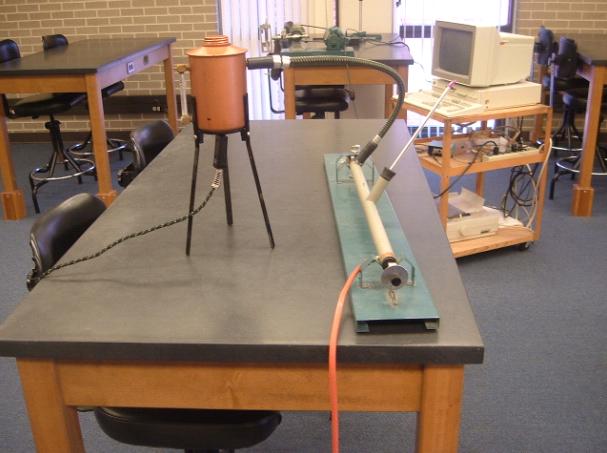
Determine the type of the metal rod. ( light gray is aluminium; heavy gray is steel and colored is copper/brass). If you are not sure what type of metal it is, ask your instructor. Coefficient of linear expansions of aluminium, steel and copper/brass are 2.4e-5 °C -1 1.1e-5 °C -1 1.7e-5 °C -1
accepted coefficient ( α ) = -1
Measure the length of the metal by means of a meter stick.
length ( Lo =
Insert the metal rod into the heat jacket through the stoppers or corks.
Make sure the end of the rod on the end without a micrometer is firmly in contact with the screw.
Make sure the screw on the other end (the screw connected to the micrometer) just touches the rod. Do not tighten the screw.
Read the reading of the micrometer. (The linear divisions are in millimeters and the circular scale is divided into 100 units, so one circular division is 0.01 millimeters)
initial micrometer reading ( Li =
Turn the screw attached to the micrometer away from the rod; but leave the screw on the other end in firm contact.
Fill the boiler with water to about two third. Place the boiler on a stool. Close it and connect it to the outlet in the heat jacket closer to the screw without a micrometer via the black tube.
Connect the outlet in the heat jacket closer to the micrometer to a rubber tube and lead the rubber tube to a beaker on the floor for drainage.
Insert a thermometer into the outlet in the middle of the heat jacket through a rubber stopper or a cork. Make sure the thermometer gets deep but not deep enough to touch the rod.
Wait until the reading of the thermometer stabilizes and record its reading.
initial temperature ( Ti =
Connect the power supply cord to the boiler and to a power outlet to heat the water. (The heater is inside the boiler)
Keep heating until the water boils and let the steam flow through the heat jacket for few minutes. Record the reading of the thermometer. (It should be about 100 °C which is the boiling point of water.) This is the final temperature ( Tf ) of the meatal rod.
final temperature ( Tf =
Using the initial temperature ( Ti ) calculated in procedure (9.), calculate the change in temperature ( ΔT ).
temperature change ( ΔT ) = Tf i =
Now forward the screw attached to the micrometer so that it just touches the rod. Note: Do not tighten the screw. Record the reading of the micrometer.
final micrometer reading ( Lf =
Calculate the expansion of the rod ( ΔL ) by subtracting the initial reading of the micrometer (procedure 6.) from the final reading.
expansion ( ΔL ) =
The coefficient of linear expansion ( α ) of a metal is given in terms of its expansion ( ΔL ), the change in temperature ( ΔT ), and its original length ( Lo ) as
α = ΔL ⁄ ( Lo
Using the expansion ( ΔL ) from procedure (14.), the change in temperature ( ΔT ) from procedure (13.), and the original length ( Lo ) from procedure (2.), calculate the coefficient of linear expansion of the metal.
measured coefficient ( α ) = ΔL ⁄ ( Lo = -1
Compare the measured coefficient of linear expansion (procedure 15.) with the accepted value (procedure 1.) by calculating the percentage error.
% error |{ accepted coefficient (1.) - measured coefficient (15.) } ⁄ { accepted coefficient (1.)}| * 100% =