One Dimensional Motion
Motion is change in location with time. One dimensional motion is motion in a straight line. This kind of motion can be described by a single number or by a number line. It can be dealt with the simple algebra of numbers.
Variables of Motion
The variables used to describe motion are position, displacement, velocity and acceleration.
Position
Position (x) is a physical quantity used to represent the location of a particle. Position is specified with respect to a certain reference point that we call the origin. The value of the position of a certain particle is not absolute. It depends on the choice of reference point. It will have different values for different choices of reference points. The SI unit of measurement for position is the meter. Positions to the right of the reference point are taken to be positive while positions to the left of the reference point are taken to be negative.
Example: Consider a number line marked with the letters A through J with consecutive letters separated by 1 cm.
Draw the number line with its markings.
Solution:

Assuming the origin is fixed at point D, Obtain the positions of points B, D and G.
Solution: Point B is 2 cm to the left of point D.
xB = -2 cm
Point D is the origin itself.
xD = 0 cm
Point G is 3 cm to the right of point D.
xG = 3 cm
Displacement
Displacement (Δx) of a particle is defined to be change in the position of a particle.
Δx = xf - xi
where xi is initial position and xf is final position. The SI unit of measurement for displacement is the meter. The displacement of a particle does not depend on the choice of a reference point. Displacement to the right is taken to be positive while displacement to the left is taken to be negative.
Example: Consider motion on a number line.
Calculate the displacement of a particle displaced from x = 3 cm to x = 7 cm.
Solution: xi = 3 cm; xf = 7 cm; Δx = ?
Δx = xf - xi = (7 - 3) cm = 4 cm
Calculate the displacement of a particle displaced from = 5 cm to x = -7 cm.
Solution: xi = 5 cm; xf = -7 cm; Δx = ?
Δx = xf - xi = (-7 - 5) cm = -12 cm.
A particle is displaced from x = 3 cm to x = 10 cm and then back to x = 1 cm.
Calculate the distance travelled.
Solution: Distance (d) is equal to the length of the path travelled.
d = |10 - 3| cm + |1 -10| cm = 16 cm.
Calculate its displacement.
Solution: Displacement depends only on the initial and final position only: xi = 3 cm; xf = 1 cm;
Δx; = xf - xi = (1 - 3) cm = -2 cm.
Average Velocity
Average Velocity (vav) is defined to be displacement per a unit time.
vav = (xf - xi)/Δt
where Δt is interval of time during which the displacement took place. The SI unit for average velocity is meter per second (m/s). Velocity to the right is taken to be positive an that to the left is taken to be negative. Average velocity between two events can be obtained from a graph of position versus time as the slope of the line joining the two events(points).
Example: Calculate the average velocity of a particle displaced from x = 20 cm to x = 15 cm in 10 seconds.
Solution: xf = 20 cm; xf = 15 cm; Δt = 10 s.
vav = (xf - xi)/Δt = (15 - 20)/10 = -5 cm/s.
Example: A particle is displaced from x = 5 cm to x = 10 cm in 7 seconds and then back to x = 5 cm in 3 seconds.
Calculate its average speed.
Solution: Average speed is defined to be total distance (d) over total time (t): d = 10 cm; t = 10 s. average speed = ?.
average speed = d/t = 10/10 cm/s = 1 cm/s.
Calculate its average velocity.
Solution: xi = 5 cm; xf = 5 cm; Δt = 10 s.vav = (xf - xi)/Δt = (5 - 5)/10 cm/s = 0 cm/s.
Instantaneous Velocity
Instantaneous Velocity (v) is defined to be velocity at a given instant of time. In other words, it is average velocity evaluated at a very very small interval of time. Instantaneous velocity at a given instant of time may be obtained from a graph of position versus time as the slope of the line tangent to the curve at the given point.
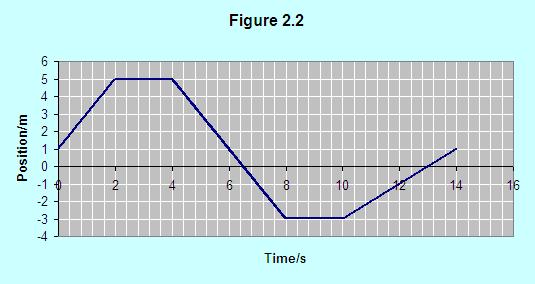
Example: The following is a graph of position versus time for a certain particle.
-
What is the initial position of the particle?
Solution: Initial position is position at t = 0.
t = 0 ; x = ?
x = 1 m
-
Calculate the average velocity between t = 2 s and t = 10 s.
Solution: The average velocity is equal to the slope of the line joining the points ( 2 s, 5 m ) and ( 10 s, -3 m ).
(ti , xi ) = ( 2 s, 5 m ) ; ( tf , xf ) = ( 10 s, -3 m ) ; vav = ?
vav = ( xf - xi ) ⁄ ( tf - ti ) = ( -3 - 5 ) ⁄ ( 10 - 2 ) m ⁄ s = -1 m ⁄ s
-
Calculate the average velocity for the entire trip.
The average velocity for the entire trip is the slope of the line joining the points ( 0, 1 m ) and ( 14 s, 1 m ).
( ti , xi ) = ( 0, 1 m ) ; ( tf , xf ) = ( 14 s, 1 m ) ; vav = ?
vav = ( xf - xi ) ⁄ ( tf - ti ) = ( 1 - 1 ) ⁄ ( 14 - 0 ) m ⁄ s = 0
-
Calculate the displacement of the particle between t = 3 s and t = 9 s.
Solution: xi = 5 m ; xf = -3 m ; Δx = ?
Δx = xf - xi = ( -3 - 5 ) m = -8 m
On what interval(s) of time is the particle
-
at rest.
Solution: When the particle is at rest, the graph of position versus time should be horizontal. Therefore the particle is at rest on the time intervals between t = 2 s and t = 4 s and between t = 8 s and t = 10 s.
-
moving to the right?
Solution: When moving to the right its velocity (slope) should be positive. Therefore the particle is moving to the right on the time intervals between t = 0 and t = 2 s and between t = 10 s and t = 14 s.
-
moving to the left?
Solution: When moving to the left its velocity (slope) should be negative. Therefore the particle is moving to the left on the time interval between t = 4 s and t = 8 s
-
What is the instantaneous velocity of the particle at t = 1 s
Solotion: If the graph of position versus time is a straight line, average and instantaneous velocity are the same. Since the graph is a straight line between t = 0 and t = 2 s, the instantaneous velocity at t = 1 s is equal to the average velocity between t = 0 and t = 2 s.
Solution: ( ti , xi ) = ( 0, 1 m ) ; ( tf , xf ) = ( 2 s , 5 m ); v = vav = ?
v = ( xf - xi ) ⁄ ( tf - ti ) = ( 5 - 1 ) ⁄ ( 2 - 0 ) m ⁄ s = 2 m ⁄ s
Average Acceleration
Average acceleration (aav ) is defined to be change in velocity per a unit time.
aav = (vf - vi)/Δt
where vf is final velocity and vi is initial velocity. The SI unit of measurement for acceleration is meter per second per second (m/s²). Average acceleration between two events may be obtained from a graph of velocity versus time as the slope of the line joining the two events. Displacement also can be obtained from the graph of velocity versus time as the area enclosed between the velocity versus time curve and the time axis. Areas above the time axis are taken to be positive while areas below the time axis are taken to be negative.
Example: The velocity of a particle changed from 5 cm/s left to 7 cm/s right in 4 seconds. Calculate its average acceleration.
Solution: vi = -5 cm/s; vf = 7 cm/s; Δt = 4 s.
aav = (vf - vi)/Δt = (7 - (-5))/4 cm/s² = 3 cm/s.
Instantaneous Acceleration
Instantaneous acceleration (a) is defined to be acceleration at a given instant of time. In other words, it is average acceleration evaluated at a very very small interval of time. Instantaneous acceleration at a given instant of time may be obtained from a graph of velocity versus time as the slope of the line tangent to the curve at the given point.
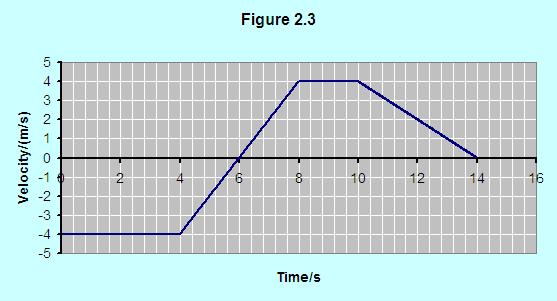
Example: The following is a graph of velocity versus time for a certain particle.
-
Calculate the average acceleration for the first ten seconds.
Solution: The average acceleration in the first ten seconds is equal to the slope of the line joining the events ( 0, -4 m ⁄ s ) and ( 10 s, 4 m ⁄ s ).
Solution: ( ti , vf ) = ( 0, -4 m ⁄ s ) ; ( tf ,vf ) = ( 10 s, 4 m ⁄ s ) ; aav = ?
aav = ( vf - vi ) ⁄ ( tf - ti ) = ( 4 - ( -4 )) ⁄ ( 10 - 0 ) m ⁄ s 2 = 0.8 m ⁄ s 2
-
Calculate the average acceleration for the entire trip.
Solution: The average acceleration for the entire trip is equal to the slope of the line joining the points ( 0, -4 m ) and ( 14 s, 0 ).
Solution: ( ti , vf ) = ( 0, -4 m ⁄ s ) ; ( tf ,vf ) = ( 14 s, 0 ) ; aav = ?
aav = ( vf - vi ) ⁄ ( tf - ti ) = ( 0 - ( -4 )) ⁄ ( 14 - 0 ) m ⁄ s 2 =
-
On what interval(s) of time is the particle
-
moving to the right?
Solution: The particle is moving to the right when the velocity is positive. Therefore the particle is moving to the right on the interval between t = 6 s and t = 14 s.
-
moving to the left?
Solution: The particle is moving to the left when the velocity is negative. Therefore the particle is moving to the left on the interval between t = 0 and t = 6 s.
-
temporarily at rest?
Solution: The particle is temporarily at rest when the velocity is zero. Therefore the particle is temporarily at rest at t = 6 s and t = 14 s.
-
On what interval(s) of time is the particle
-
moving with aconstant velocity?
Solution: The particle moves with a constant velocity when its acceleration is zero or when the graph of velocity versus time is a horizontal line. Therefore the particle is moving with a constant velocity on the time intervals between t = 0 s and t = 4 s and between t = 8 s and t = 10 s.
-
increasing its velocity?
Solution: The velocity of the particle increases when the acceleration or slope is positive. Therefore its velocity is increasing on the interval between t = 4 s and t = 8 s.
-
decelerating?
Solution: The particle decelerates (its velocity decreases) when its acceleration or slope is negative. Therefore it is decelerating on the time interval betwee t = 10 s and t = 14 s.
-
Calculate its instantaneous acceleration at t = 2 s.
Solution: At t = 2 s, the tangent line is horizntal and the slope of a horizontal line is zero. Therefore the instantaneous acceleration at t = 2 s is zero.