Heat
Heat is energy in transit from an object at higher
temperature to an object at lower temperature. The SI unit of measurement for
heat is the Joule. Another common unit of measurement of heat is the Calorie,
abbreviated as Cal. A Calorie is defined to be equal to the amount of heat
energy required to raise the temperature of one gram of water by one °C. It is
equivalent to 4.18 J.
Heat and Change of Temperature
For a given substance, amount of heat
supplied is directly proportional to the change of its temperature. For a given
change in temperature, amount of heat supplied is directly proportional to mass.
Q = mcΔT
Q stands for the amount of heat supplied (lost). c is a
material constant called specific heat capacity of the substance. Specific
heat capacity of a substance is defined to be the amount of heat energy
required to raise the temperature of one kilo gram of the substance by one °C.
The unit of measurement for specific heat capacity is J ⁄ kg ⁄ °C. For example,
4180 J of energy is required to raise the temperature of one kilo gram of water by one °C.
Therefore specific heat capacity of water is 4180 J ⁄ kg ⁄ °C.
Mixtures
When a hot substance is mixed with a cold substance, heat will
flow from the hot substance to the cold substance until both of them have the
same temperature. This temperature is called equilibrium temperature. From the
principle of conservation of energy, the amount of heat lost (
Qh ) by the hot object is equal to the amount
of heat gaind ( Qc ) by the cold object.
Qc =
-Qh
The negative is required because loss is taken to be negative and gain is
taken to be positive. Suppose a hot substance of mass
mh , specific heat capacity
ch and temperature
Th is mixed with a colder substance of mass
mc , specific heat capacity
cc and temperature
Tc and the final equilibrium temperature is
found to be Tf . Then the heat lost by the hot
substance is Qh = mh
ch ( Tf -
Th ) and the heat gained by the colder substance
is Qc = mc
cc ( Tf -
Tc ). Applying the principle of conservation of
energy, the following equation for mixtures is obtained.
mc
cc ( Tf -
Tc ) = -mh
ch ( Tf -
Th )
Heat and Phase Changes
There are three phases of matter. These are
solid, liquid and gas phase. Solid phase is a phase with a fixed shape and a
fixed volume. Liquid phase is a phase with a fixed volume but not fixed shape.
Gas phase is a phase with no fixed volume and no fixed shape. One phase can be
changed to another by the supply or loss of heat. During a phase change, the
amount of heat supplied is used to break the bonds between the molecules and not
to increase the kinetic energy of the molecules. Thus, temperature remains
constant during a phase change. For example, during the melting process, the
temperature remains constant at the melting temperature until the substance
melts completely.
Latent Heat of Fusion
Amount of heat required to melt (freeze) a
substance at the melting (freezing) temperature is directly proportional to the
mass of the substance. The amount of heat required to melt (freeze) one kilogram
of a substance at the melting (freezing) temperature is called the Latent
heat of fusion of the substance. The unit of measurement for latent heat of
fusion is J ⁄ kg. For example, 334000 J of energy is required to melt
(freeze) ice (water). Thus Latent heat of fusion for water is 334000 J ⁄
kg.
Hf =
mLf
Hf is the amount of heat required to melt a
substance of mass m at the melting temperature.
Lf is the latent heat of fusion of the
substance.
Latent Heat of Vaporization
The amount of heat required to vaporize
(condense) a substance at the boiling temperature is proportional to the mass of
the substance. The amount of heat required to vaporize (condense) one kilogram
of a substance at the boiling temperature is called the latent heat of
vaporization of the substance. The unit of measurement for the latent heat
of vaporization is J ⁄ kg. For example 2.26e6 J of energy is required to
vaporise (condense) water (steam). Therefore Latent heat of vaporization of
water is 2.26e6 J ⁄ kg.
Hv =
mLv
Hv is the amount of heat required to melt a
substance of mass m at the boiling temperature.
Lv is the latent of heat of vaporization of the
substance.
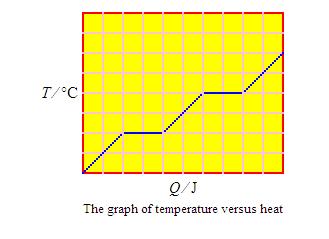
The Graph of Temperature versus Heat
As a solid is supplied with heat,
its temperature will increase linearly with the heat supplied until the melting
temperaure is reached. Once the melting temperature is reached, the heat energy
is used to break the bonds among the solid molecules to form liquid and not to
increase the kinetic energy of the molecules. Thus the temperature remains
constant during the melting process. Once the solid has completely melted, once
again the heat energy is used to increase the kinetic energy of the liquid
molecules and the temperature of the liquid increases linearly with the amount
of heat supplied until the boiling temperature is reached. Once the boiling
temperature is reached, the heat energy is used to break the bonds among the
liquid molecules to form gas and not to increase the kinetic energy of the
molecules. As a result, the temperature remains constant at the boiling
temperature during the boiling process. After all the liquid has vaporized, the
heat energy is used to increase the kinetic energy of the gas molecules and the
temperature increases linearly with the amount of heat supplied.
The following is a general representation for the graph of temperature versus
heat for an arbitrary substance. The temperature at the lower horizontal line of
the graph is the melting temperature ( Tm ) of
thesubstance. The temperature at the upper horizontal line is the boiling
temperature ( Tb ) of the substance. The phase
at the lower slanted line is pure solid. At this interval the amount of heat and
change in temperature are related by Q = mcs ΔT
where cs is the specific heat capacity of the
solid phase. At the lower horizontal line the solid is melting and the phase is
a mixture of solid and liquid. On this interval the amount of heat and the
change in temperature are related by Q = mLf.
At the middle slanted line the phase is pure liquid. The amount of heat and the
change in temperature are related by Q = mcl ΔT
where cl is the specific heat capacity of the
liquid phase. At the upper horizontal line the liquid is vaporizing and the
phase is a mixture of liquid and gas phases. At this interval, the amount of
heat and the change in temperature are related by Q =
mLv . At the upper slanted line, the phase pure
gas. At this stage the amount of heat and change in temperature are related by
Q = mcg ΔT where
cg is the specific heat of the gas phase.
To calculate the amount of heat for a change of temperature encompassing
different stages, the amount of heat for each stage should be calculated first
and then added. For example, to calculate the amount of heat required to convert
ice at -10 °C to water at 80 °C, first the amount of heat needed
to convert ice at -10 °C to ice at 0 °C, the amount of heat needed
to melt the ice completely and the amount of heat needed to convert water at
0 °C to 80 °C should be calculated separately and then added.
Chapter 11 Lecture 2
Ways of Transfer of Heat
There are three ways by which heat can be transferred from one point to another. These are conduction, convection and radiation.
Conduction
Conduction is the transfer of heat through the collision of neighboring molecules. For example, when one end of a metal is heated, the molecules at that end will vibrate vigorously. This energy is transferred to its neighboring molecules by means of collision. This process repeats itself again and again from neighbor to neighbor and eventually is transferred to the other end of the metal.
The rate of transfer of heat in a metal rod by means of conduction is proportional to the cross-sectional area ( A ) of the rod and to the temperature difference ( T2 - T1 ) between the ends of the rod and inversely proportional to the length ( L ) of the rod.
Q ⁄ Δt = κA( T2 - T1 ) ⁄ L
Q is amount of heat transferred from one end of the rod to the other end in a time interval Δt. That is Q ⁄ Δt is the rate of flow of heat. The unit of measrement of rate of flow of heat ( power ) is J ⁄ s which is defined to be the Watt, abbreviated as W. κ is a material constant called thermal conductivity of the material. The unit of measurement for thermal conductivity is W ⁄ m ⁄ °C.
Convection
Convection is transfer of heat by the actual movement of molecules. This applies to liquid or gas molecules. When molecules at the bottom are heated their density decreases and they rise up. The more dense molecules at the top come down taking their place. This way heat is transferred from the bottom to the top by the actual movement of molecules. For example, when water in a dish is heated, first the molecules at the bottom of the dish are heated. Their density decreases and they rise up and the more dense molecules at the top fall down resulting in the transfer of energy from the bottom to the top.
Radiation
Radiation is the transfer of heat by means of electromagnetic waves. Any hot object emitts electromagnetic waves. Electromagnetic waves encompasses a wide range of waves including light waves. A small subset of these waves called infrared wave causes sensation of heat. It is a common experience that a light bulb also causes sensation of heat in addition to sensation of vision. This is because the electomagnetic wave emitted by the light bulb contains infrared waves.
Stefan's Law states that the rate of emission of electromagnetic energy by an object is proportional to the fourth power of temperature in degree Kelvin.
Pe = σeATe 4
Pe is the rate of emission of electromagnetic energy by an object of surface area A at a temperature Te in degree Kelvin. Rate of emision of energy is equal to energy emitted per a unit time ( Pe = ΔE ⁄ Δt ). The unit of measurement of emission rate is Watt. e is a constant called emissivity that depends on the properties of the surface. Its value is between 0 ( for no emission ) and 1 ( for perfect emmission ). It is unit-less. σ is a universal constant called Stefan-Boltzman constant. Its value is 5.7e-8 W ⁄ m 2 ⁄ °K 4.
σ = 5.7e-8 W ⁄ m 2 ⁄ °K 4
An object not only emitts electromagnetic energy to its enviornment but also absorbs electromagnetic energy from its enviornment. The rate of absorption of energy from the enviornment is proportional to the fourth power of the temperature of the enviornment in degree Kelvin.
Pa = σeATa 4
Pa is the rate at which radiation energy is absorbed by an object of surface area A whose enviornment is at a temperature Ta. The net rate of emission ( Pnet ) of radiation is the difference between the emission rate and absorption rate.
Pnet = Pe - Pa = σeA( Te 4 - Ta 4 )